
Natural history and mythology share a landscape in common
I was standing beneath the branches of a centuries-old Limber pine, contemplating the accomplishment of its life and admiring its three main trunks, pointing like a trident into the sky. It was a clear August morning. Nearby, a ridgeline of knee-high grass flowed south, overlooking the azure shores of Bear Lake and the idyllic town of Garden City, where I had been staying with family for a couple of days. The contrast between the beachtown and the forest was sublime.

I had dropped my backpack at the foot of the tree, well aware that I was the first visitor of the day–a rare occurrence in this age of faddish recreation. While resting beneath the ancient tree, I watched the morning sunlight filter through the remaining forest, washing over treetops before percolating down to the understory. At the trailhead, I had learned that Clark’s Nutcrackers had done a lot of work here, using their wings and beaks to scatter an estimated 30,000 tree seeds across the surrounding range.
I’d been wanting to do this hike for some time, not for physical fitness–the trail is barely over a mile long–but because the surrounding area had something in its history that called to me. This corner of the Uinta-Wasatch-Cache National Forest had a story to tell that went beyond ancient trees–it was a holdout of sorts, for the deepest kind of wilderness, where nature and mythology were intertwined.
“Old Ephraim” was the last known grizzly to roam the State of Utah. Standing ten-feet-tall on two legs and weighing over 1,100 pounds, the local shepherds called him “Three Toes,” after one of his forepaws was injured while tangled in a steel trap. Leaving his crooked print wherever he went, he wandered the mountains between Bear Lake and Logan for many years, eluding poisoned bait and bullets alike.
But the great bear finally met his end on an August night 100 years ago, when a trapper named Frank Clark, desperately looking to avenge the deaths of hundreds of sheep, finally found his chance. As Clark’s hound dogs assailed the trapped bear, he fired shots from an under-powered rifle, merely killing by degrees. Old Ephraim died slowly overnight while Clark listened and waited in the dark.
In his story “The Bear,” William Faulkner beautifully encapsulates the simultaneous glory and emptiness of the trapper’s toil and the ferocity of his foe:
He had already inherited then, without ever having seen it, the big old bear with one trap-ruined foot that in an area of almost a hundred square miles had earned for himself a name, a definite designation like a living man–the long legend of corncribs broken down and rifled, of shoats and grown pigs and even calves carried bodily into the woods and devoured, and traps and deadfalls overthrown and dogs mangled and slain, and shotgun and even rifle shots delivered at pointblank range yet with no more effect than so many peas blown through a tube by a child–a corridor of wreckage and destruction beginning back before the boy was born, through which sped, not fast but rather with the ruthless and irresistible deliberation of a locomotive, the shaggy tremendous shape. It ran in his knowledge before he ever saw it. It loomed and towered in his dreams before he ever saw the unaxed woods where it left its crooked print, shaggy, tremendous, red-eyed, not malevolent but just big, too big for the dogs which tried to bay it, for the horses which tried to ride it, for the men and the bullets they fired into it; too big for the very country which was its constricting scope.
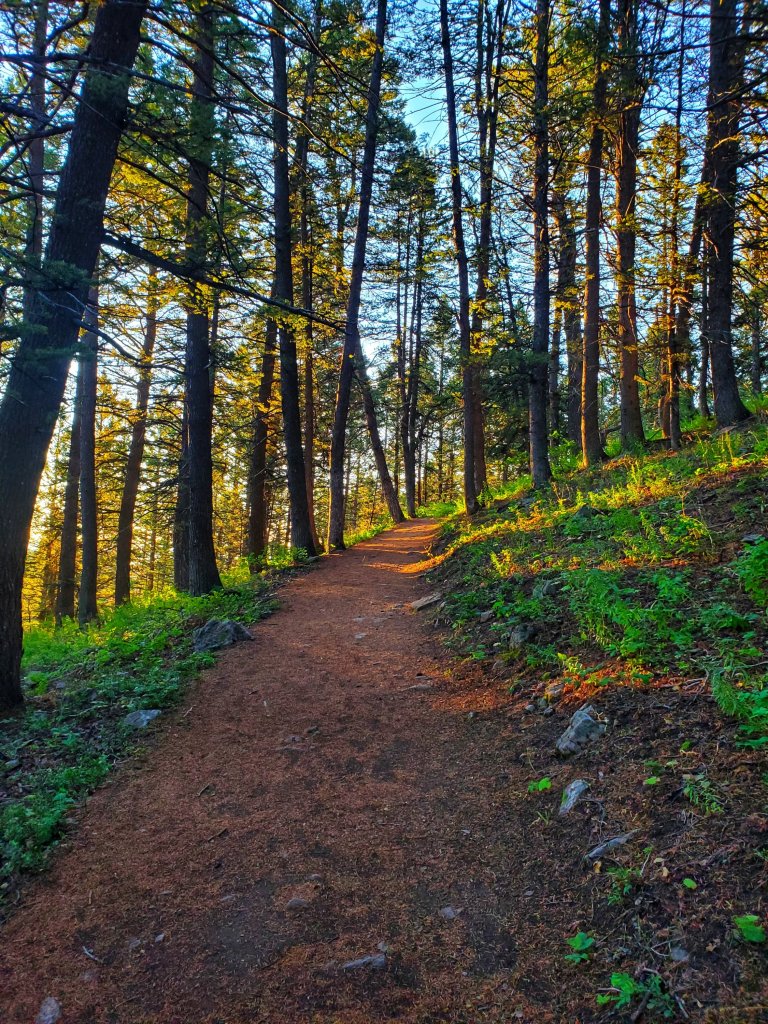
With my eyes overlooking this related country, and my mind thinking back, I felt the peculiar amalgamation of triumph and disappointment. It was still very much that ancient wilderness, but it had been changed forever, diluted and domesticated by the assault of good intentions.
That doomed wilderness whose edges were being constantly and punily gnawed at by men with plows and axes who feared it because it was wilderness, men myriad and nameless even to one another in the land where the old bear earned a name, and through which ran not even a mortal beast but an anachronism indomitable and invincible out of an old, dead time, a phantom, epitome and apotheosis of the old, wild life which the puny humans swarmed and hacked at in a fury of abhorrence and fear, like pygmies about the ankles of a drowsing elephant,–the old bear, solitary, indomitable, and alone; widowered, childless, and absolved of mortality–old Priam, reft of his old wife, and outliving all his sons.
William Faulkner–“The Bear”
My surroundings made it easier to get lost in nostalgia. I imagined Ephraim chuffing and rooting as he might have passed beneath this same tree on a morning just like this. I was reluctantly grateful for the Boy Scouts who, at some point after Ephraim’s death, exhumed his remains and, more nobly, donated his skull to the Smithsonian and later the Utah State University. (https://en.wikipedia.org/wiki/Old_Ephraim) The donation likely helped the legend to go beyond just the back porches of sheep men and ranchers.
My backpack still leaned against the base of the Limber at its widest point, as wide as a car. I saw other smaller and younger specimens of Limber, some “only” 200 to 300 years old, and a long-forgotten wooden railing which marked a spot where early forest managers had apparently attempted a makeshift viewing platform, probably an effort to protect the roots of the old tree, which were now partially exposed and thick as railroad ties.
The trail leading up to the Limber had been well-groomed. I had entered the forest to the sounds of squirrels and birds echoing into the still warming air, taking the left-fork first and then climbing a fairly steep incline through shimmering fir and aspens, alternated with clumps of mountain mahogany and gamble oak.
The trail going back held more of the same beauty. To the west, was a mosaic of treelines and clearings–good bear country that was now filled with summer sun. The trail was bright and cheerful and the rockless dirt underfoot was full of organic material, giving it a sort of sponginess that returned energy and made my footsteps light. I passed a few pines bent from years of heavy snows, one at nearly a 90 degree angle, like a chair.
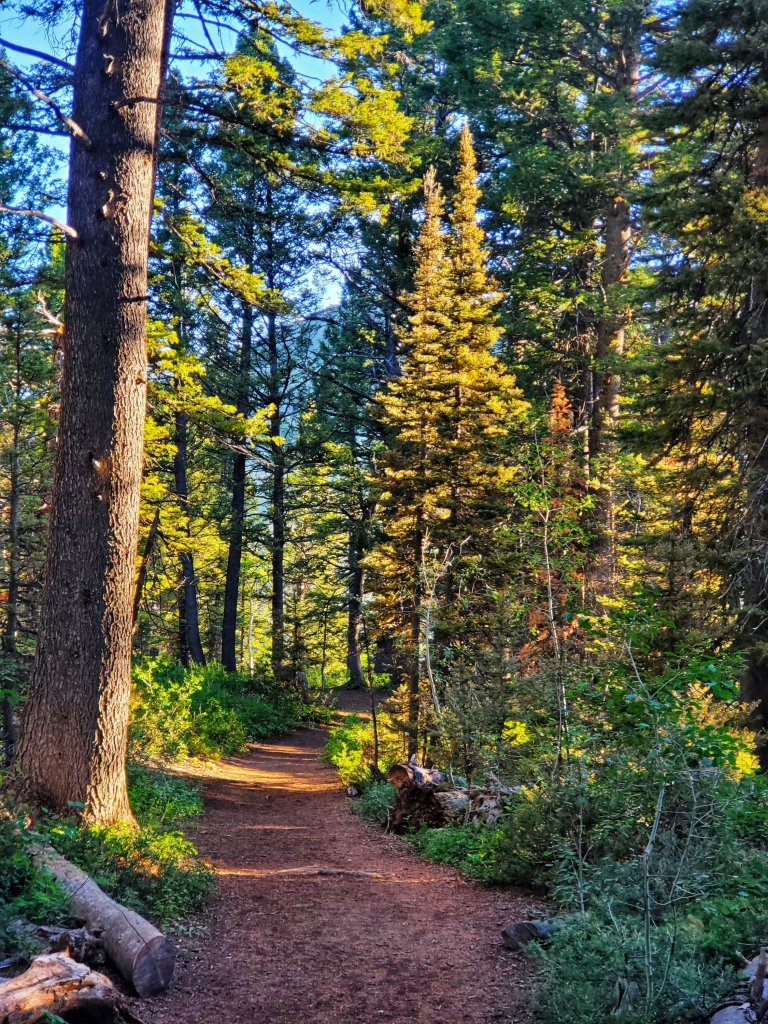
As I rounded a bend on the western section, I came into a small clearing with a good view. Recent rains had left mud puddles and it was in one of these that something caught my eye. It was a fresh black bear track transecting the path, headed back to the east toward the Limber. By the looks of it, the bear was small, maybe even a cub from last year. But it was definitely on top of the other tracks and had likely been made within the last couple of hours. I got some photos, looked around anxiously (more so for the mother than for the cub) and continued on.
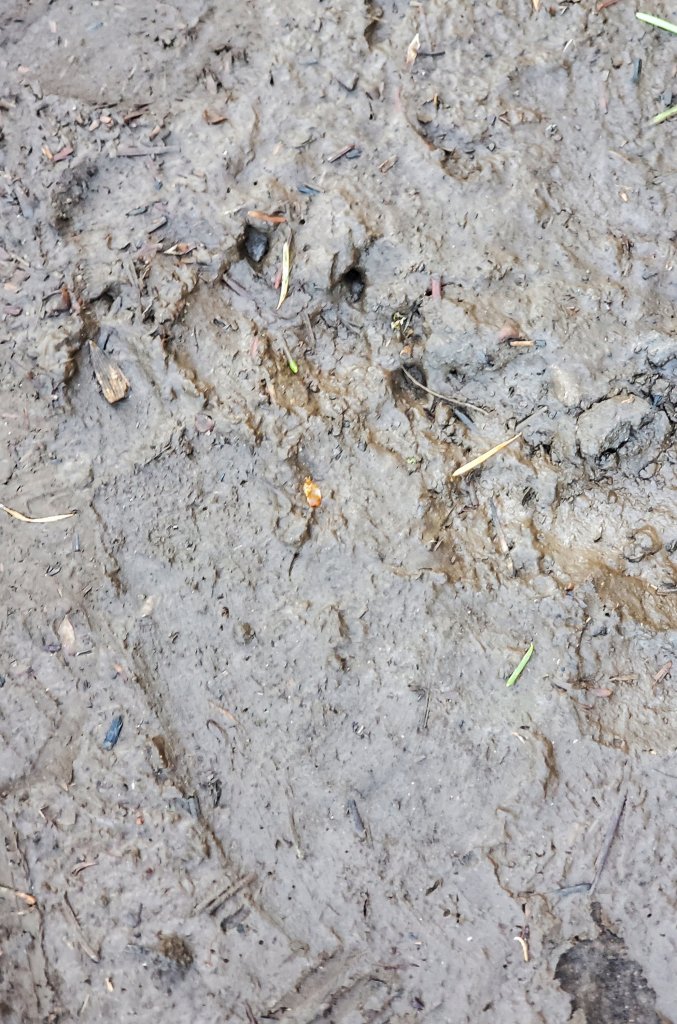
It had been a poetic, even ironic discovery. The bear print was a reassurance that the wilderness here, while profoundly changed from Ephraim’s time, was not completely lost. There was still continuity, flowing like a river between the ancient and the modern. The old tree was still holding this line in both time and legend. And it appeared that the bears, in their own way, were holding it too.
 The Desert Toad