King of the Borderlands

How a wandering jaguar changed my view of the wilderness
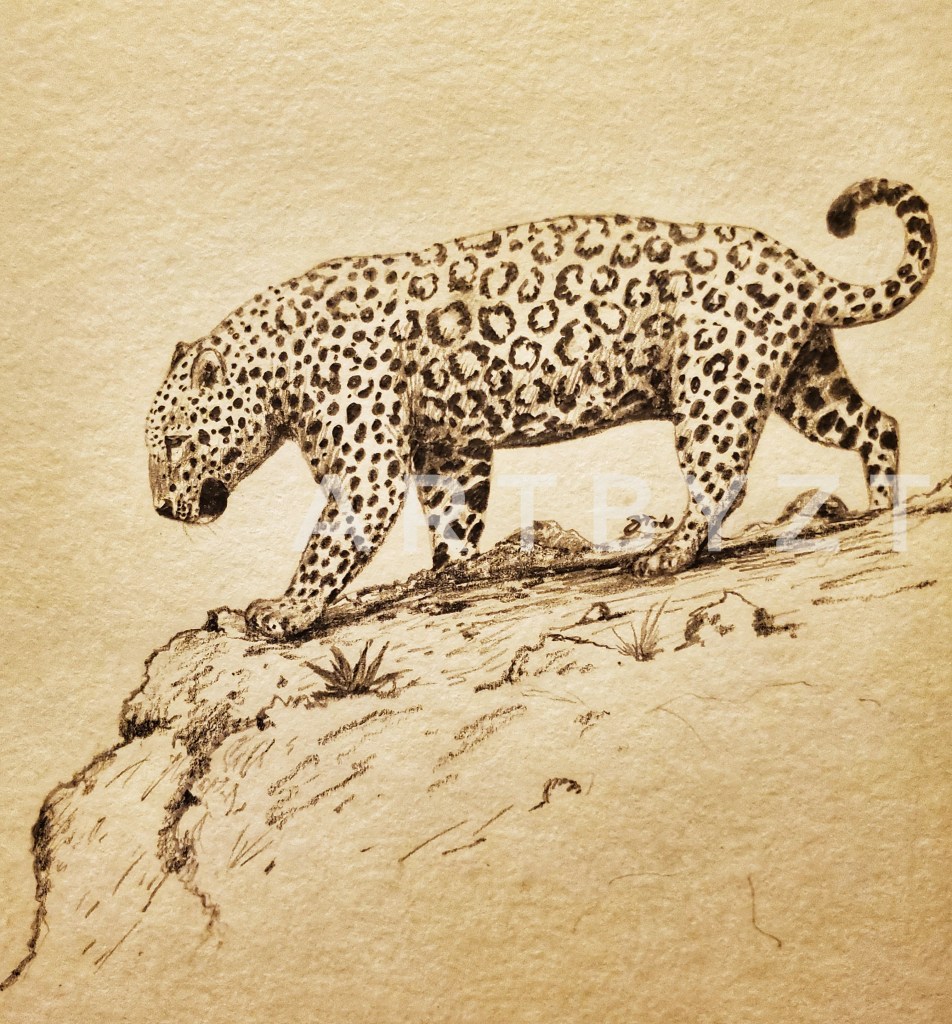
The desert jaguar…Artbyzt.

Natural history rarely turns on a dime, but the story of El Jefe the jaguar wasn’t fit for any stale museum halls.  It was hard to believe at first.  A jaguar.  In the mountains of southern Arizona.  The trail cam footage on the evening news was captivating, and quickly gained a wide audience.  

I’ve always been fascinated by big cats and the mystery and power they bring to the wilderness.  But while watching El Jefe, as he deftly crossed a creek bed in the Santa Rita Mountains, I realized my perception of big cat habitat was cliche and needing expansion.  It was no longer just about Indian jungles, African savannahs, or the Pantanal of South America–the kind of steamy, verdant, places that are the pride of National Geographic photographers.  It was time to consider places lonelier, drier, closer to home.

“He’s got swagger,” I thought, while watching the clip again.  “El Jefe…a perfect name for the boss of the desert.”  He was definitely going somewhere as he softly stepped over logs and scrubby branches–his eyes like fire and muscles rippling under amber, spotted fur. 

I’m not a frequent visitor, but the U.S. / Mexico border doesn’t seem like the place to hang out.  It’s troubled there by all accounts, a crossing place for desperate people and criminals–home to impassable walls, and surrounded by unforgiving, often deadly terrain.  Water is probably less than scarce, meaning food for any large predators would be scarce too. 

And (as was clear in the video) jaguars need room to roam and they need contiguous habitat, which means the border represents a significant obstacle to conservation efforts.   

Was he looking for a mate?  Escaping an enemy?  Or just on patrol, like a junkyard dog checking the edge of his lot?  What was his last meal?  What would be the next?  A javelina?  A bird?  A snake? 

For some time, after being spotted, treed and then photographed by a cougar hunter and his daughter in 2011, El Jefe was documented on trail cameras in the area, with the most public images being released in 2012 by the U.S. Fish and Wildlife Service.  He was given his name by students at a middle school in Tucson, and was believed to be part of the northernmost breeding population of jaguars in Mexico.  He was important scientifically because he represented one of the only known specimens of jaguar since the species was believed to have been extirpated in the United States.  El Jefe (jaguar), Wikipedia, 18 January 2023, https://en.wikipedia.org/wiki/El_Jefe_(jaguar))

There was another, less public, account of a jaguar named Macho B who had been haunting the area in the years prior.  And there have probably been others to cross since.  But it was El Jefe who became a kind of mascot for amplifying the possibility of jaguars someday living and thriving again in the U.S. 
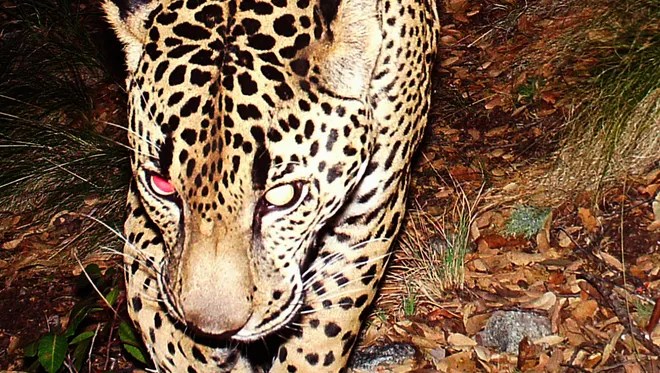
El Jefe, Conservation CATalyst And Center For Biological Diversity. Arizona Sonora News, Posted 17 February 2017

It’s said that jaguars are the third largest of the big cat species, which added another layer of intrigue.  Desert climates rarely support large animals, let alone large carnivores.  When it comes to the desert, scarce resources usually account for slow, modest growth in plants and everything that depends on them.  

To be clear, there are other cats living in improbable places around the world.  There are lions on the beaches and dunes of Namibia, leopards on the high cliffs and in the seaside canyons of Oman, tigers in the cold forests of Siberia.  And, of course, there’s the snow leopard which seems to be on its own level of habitat utilization. 

Leopards, especially, are good at adapting to atypical habitats, as is the case with the urban leopards of New Delhi.  Since jaguars in Mexico are on the fringe of their habitat to begin with, Arizona could probably be considered ultra-fringe.  

But part of what makes El Jefe’s story so inspiring is that it only appears unnatural on a knee jerk level.  In reality, it’s a perfect story from a landscape where surprises are built in. 

It could also be said that the personality of the desert is inherently subdued, independent and resistant to categorization.  El Jefe, and the other jaguars who crossed the border before him, and undoubtedly since, mirror these traits.  Obviously, there won’t be a large population of them in the American desert anytime soon, if ever.  But, for now, just appreciating the outliers is good enough for me.      

Maybe I’ll travel there someday, to those remote southern mountains, knowing that my chances of seeing a wild jaguar will be next to nothing.  But at least I could get closer, and see some of where this story took place, all the while hoping for more to come. 

Then, as the fierce daylight fades into purple skies and sparkling stars, I could get goosebumps as I glance back into the scrub.  I could move closer to the fire, maybe sip on a mug, and picture that big, inspiring cat, making his rounds, out in the darkness and the rocks.

Yard Survivors

For the past couple of years, it’s been so dry in the Southwest that it’s easy to see how any residential or commercial growth could simply become unsustainable in short order.  Just driving around town, on some of the furnace-like days last summer, it was easy to see.  Even the desert plants, which often give only subtle clues about their health, were obviously struggling.  And the heat seemed more edgy.  I mean, there’s hot and then there’s really hot.  Parking lots felt like skillets and the white tables at the snow cone shops were covered with red syrup stains that looked like crime scenes–evidence of treats that melted before they could be eaten.  

Despite the obvious difficult conversations and realities about water out here, there’s been a booming real estate market and development frenzy going on.  Of course, all these new yards require decisions about plant design, including what plants are up for the xeriscape challenge.  Above all this, one thing is clear; you can’t put just anything in this hard desert ground and expect it to survive.  The local nurseries usually do a decent job of offering desert savvy plants, although it’s still possible to buy some types that are just plain doomed from the outset.  

I experienced this last year while attempting to put more plants in my yard.  Two Carolina Laurels went on the nursery cart during pretty much an impulse buy.  They looked nice, with their bright green waxy leaves that were a good size and shape.  I needed some evergreens for a backyard screen between me and the neighbors.  For some reason, I remember checking all the height and spread dimensions, but somehow blundered over the water requirements, which were “moderate,” a description which I have come to see as meaning “You’ll have to water them more than you think.”  But I didn’t understand this yet, and so on the cart they went, off to the checkout counter and then on to a slow death over several weeks in my backyard.  Despite what I thought was a valiant effort, it was terribly dry for a long time and I just couldn’t keep up.  The laurels first began to stress, then cling to life, and then, after a week-long vacation, my relationship with them was finally over.

And so this begs the question, “Just how much should you pay attention to water requirements when it comes to buying outdoor plants in the Southwest?”  Well, I’m beginning to see that it should probably be your first consideration, even above aesthetics.  First make sure the plant can be a true survivor, then think about how to work it into your landscape design.  

To be fair, I didn’t do everything wrong in planting last summer.  I did buy a beautiful Blue Agave and was lucky to put it in a good spot, with apparently the right amount of light because now it’s thriving.  The Agave survived the same brutal summer that incinerated the laurels.  And, with the consistent rain this winter, and what’s finally looking like a decent snow pack up north, I think it’ll be a beautiful part of our yard for the long haul.   

Blue Agave (Agave Tequilana) courtesy of ZT

Visitor under the truck

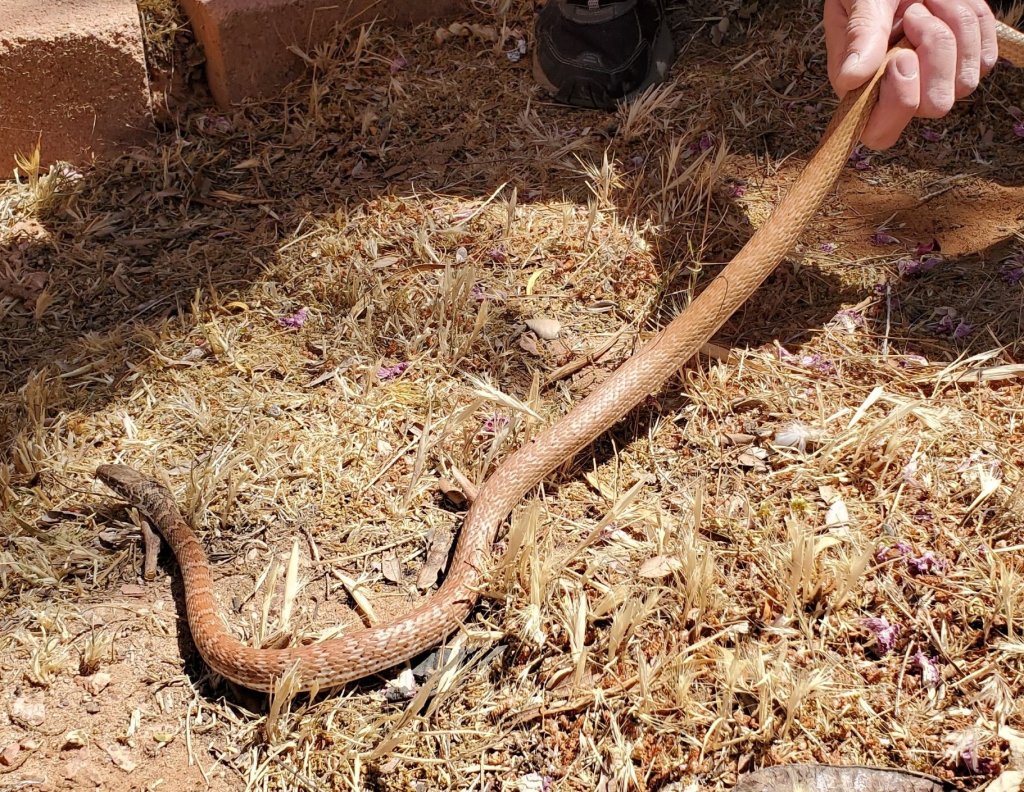
On a bright June morning, while getting ready for a camping trip, my boy spotted something moving quietly beneath our pickup. It’s a standard part of being a dad to get your attention drawn away by the kids, especially when you’re trying to pull off a full blown operation for their benefit. As was usual during such times, I was busy packing and didn’t want to see what he was trying to point out. “Oh my gosh, look Dad!” he said. And when I did look, I saw it too–a long reddish brown snake with round black eyes and stripped scales on his neck. While I’m sometimes turned off by people putting human emotions, or human characteristics on animals, (Anthropomorphism isn’t necessarily harmless), I could swear that this snake actually appeared to be introducing himself to us.

Of course, I had to catch him for a minute–to get a better look. He was a coachwhip snake, and he didn’t really fuss about it. I held him gently but firmly by his whip-like tail. We got some pictures and admired him for a few minutes. His visit constituted a rare show of desert hospitality. When we were satisfied, we let him go, and off he slithered into a pile of warm rocks near the fence, presumably to catch some breakfast. My boy’s eyes were left wide open, and my eyebrows lifted. We’d seen many wild snakes before. But this time, a snake had come to see us.

Drought Trouble

It’s been an especially long, hot and dry summer in the southwest.  Not since March has there been a substantial rain storm–I mean the kind that really soaks the ground and rattles the skies. Everything is crispy and has taken on that pale yellow, reserved only for the driest times.  The grass is often like powder.  The wild birds have taken to eating all of this year’s peaches, likely for water more than taste.  I washed the kitchen rug a couple days ago and saw a honey bee trying to suck some remaining water from the fibers of the rug.  Just this morning, I saw a huge raven taking a bath in a gutter, a gift from some watered lawn up the street.  His black, blue tinged feathers were drying quickly in the furnace-like heat coming off the sidewalk nearby. 

For the past few weeks,  the air has been more often smoky than not.   It’s a diffused, sinister kind of smoke that’s atmospheric, foreign.  The temperatures are still in the middle to upper 80’s going into late September.  They say 27 wildfires are currently burning in California.  The smoke reaches us here, as if we don’t have enough of our own.   And the wind comes too, each afternoon, steering dust devils into the hazy blue.   They lean across the landscape, like drunks, carrying last year’s dead leaves, tipping over wheelbarrows.  And then there’s the dust, the neverending dust–on the cars, in the eyes, filling the porch steps as soon as you sweep it off.  Somehow, through all this, the farmers are still finding some for the fields. 

I’ve never been one to beg for rain.  It’s a desert here for crying out loud.   Drought is not only common, it’s what makes the place what it is.   But, though I’m not a farmer, I do know where my food comes from.  And I know when we’re long overdue for rain. This time, when it does finally come, I’ll be very glad to see it again.

Swallowtail Butterfly

Pride of the Horned Toad

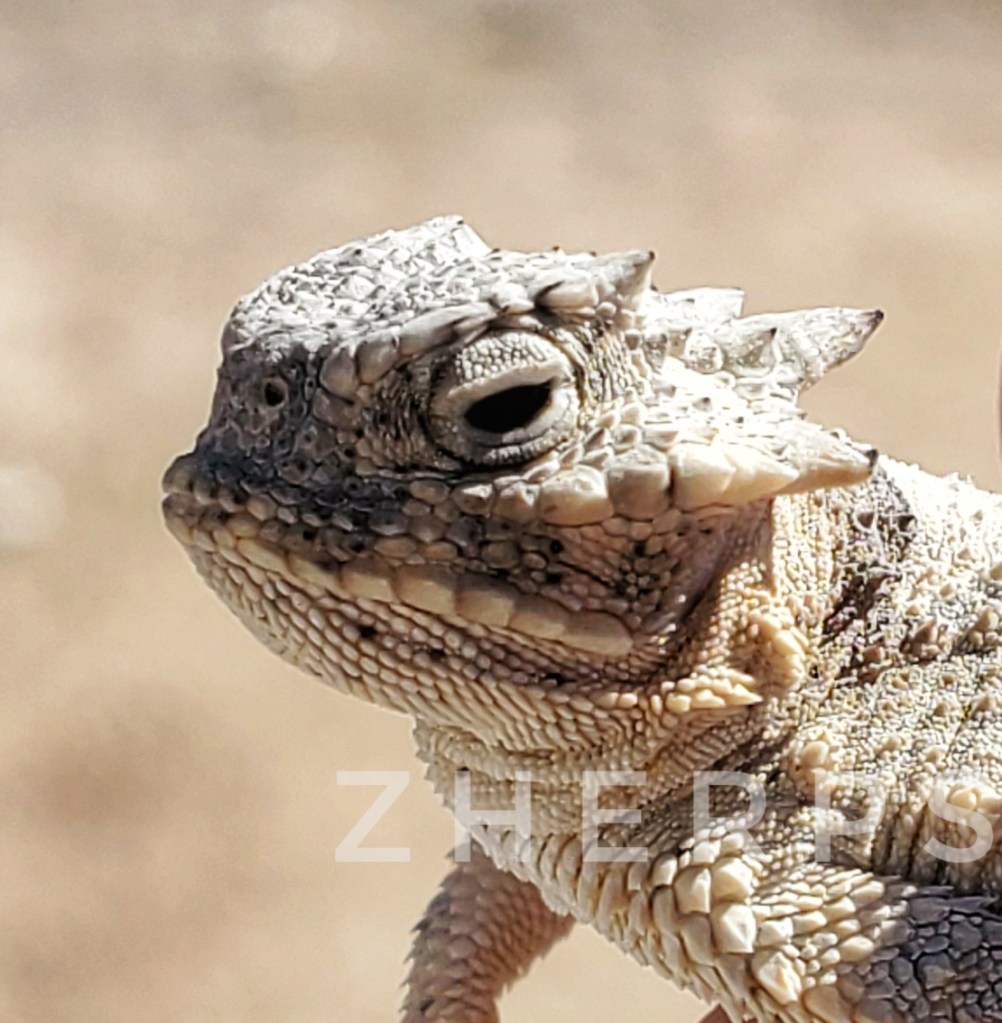
If the word “smugness” had a face it would be that of the Horned Toad. Hardly a lizard and hardly a toad, he seems, accordingly, to look at the world with only contempt and suspicion. We found one under a bear claw poppy one bright autumn morning in the mojave.

He was a juvenile. His scales were lighter than most we had seen thus far, probably to camouflage himself on the white clay of the surrounding area. We were lucky to spot him and not glance him over as a pebble. I held him for a moment and he looked at me without emotion. Most lizards try to bite or escape. He did neither.

“Do your worst,” he seemed to say. I put him back exactly as I had found him; he would accept nothing less.

The ambivalent Horned Toad

The Tarantula Hawk and other disturbances.

The desert has a way of rejecting excessive admiration. I was hiking down a trail one early August evening, along a scenic area of Southern Utah’s Escalante Desert. The sun was still ferociously hot, and the boulders along the trail felt like giant charcoal briquettes. Nonetheless, it was a beautiful evening. My boy, red-cheeked, was hiking with me, looking for good handholds on the rocks, or maybe a lizard to chase–whichever came first.

And then suddenly she appeared, from around the corner of a nearby boulder, with amber wings buzzing and her black and blue body weilding a stinger capable of causing pain like a mini lighting strike–five seconds of paralysis according to those who’ve been through it. The Tarantula Hawk, a wasp who lays her eggs in the dead bodies of the spiders she kills. Something straight out of nature’s horror movie collection. My boy was traumatized by her presence. We could only freeze and watch until she passed…

It was a reminder that the desert won’t be adored too much. If dehydration and the Tarantula Hawks aren’t enough, there are the scorpions, camel spiders, sandburs, rattlesnakes, red ants, and prickly pears… Keeping us in our place. Reminding us that comfort is not being offered.

The Tarantula Hawk

Walkabout

It has become a special term for me. It means breaking away, finding solitude, sun and silence. I was introduced to the term by the movie Crocodile Dundee, and so it was imbued with lore and mystique. Australians can surely lay claim to it. But desert travelers anywhere can also relate. “Walkabout”…I like it. It fits…

Abbey’s Turf

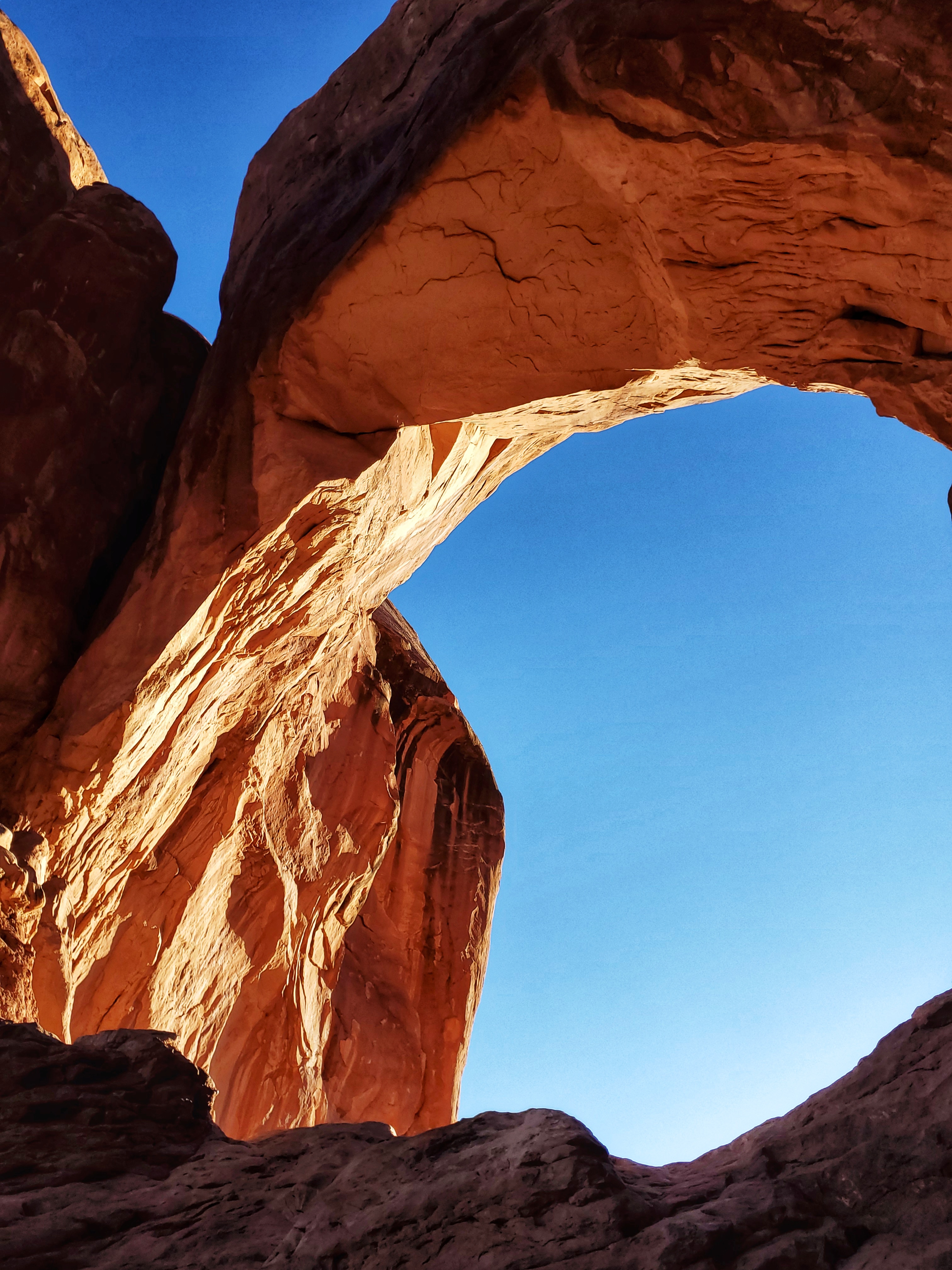
We paid a visit last evening to double arch in Arches National Park. The trail was short and wide and still populated, even at dusk. On the way in, we had stopped at the visitor center, only to find it closed for the day. While walking back to the car, I passed the water station, where the truly conscientious can fill (or refill) their own water bottles (sparing the world’s landfills some of the 67 billion plastic water bottles used by Americans each year, according to a nearby sign). While one man completed his refill, I saw another man and woman exit a truck and desperately approach the station. They were dressed for the beach, sunburned and traumatized. I’m not one for eavesdropping, but as I passed, I heard something about “eight miles” and “all day.” The man looked violated as he glanced back toward the park.

“The desert doesn’t care about you,” I thought to myself while driving past balanced rock toward the windows district and double arch. We were just in time to catch some evening light on the sandstone.

On the way out, a young park ranger was getting her picture taken on the trail. She was beaming as she told me this was her first assignment–she was about four months on the job. I asked her and the photographer if they’d ever read Desert Solitaire, Abbey’s quintessential manifesto on Arches. The photographer chimed in and said he was halfway through it.

“He’s opinionated,” the photographer said, and I couldn’t argue with that. “Ya, he probably wouldn’t want us all here , but hey,” I said. The young ranger smiled but didn’t reply. I was entering conflicted territory with such a conversation. Better to stick to talking about the park service junior ranger program…

While driving out of the park, I stopped to take a picture and suddenly heard “Excuse me Sir.” A pickup truck had pulled up behind me, and a woman asked “Where’s the big arch?” I pointed up the road. “It’s up there, called Delicate Arch.” They thanked me and drove away, pulling a trailer with a side-by-side on it. Never mind that it was getting late, the hike to Delicate Arch is fairly long and rigorous, and they had a small child. It seemed an appropriate ending to the evening. Delusion and freedom driving off together–two days before Independence Day on Edward Abbey’s turf.