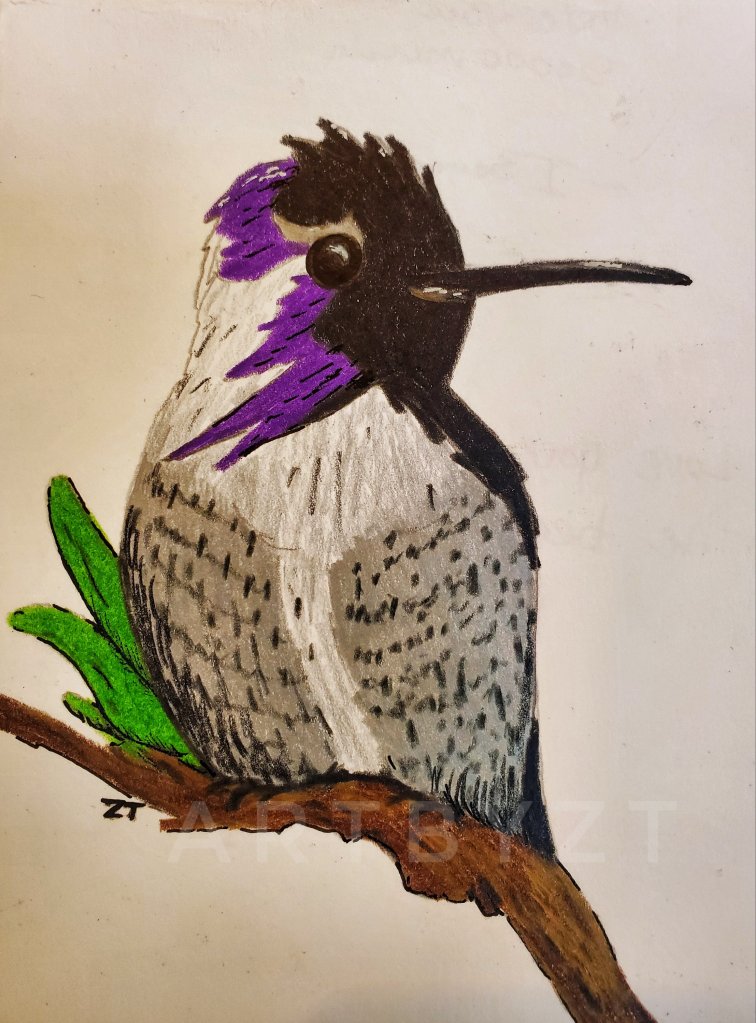
Free-roaming cats kill an estimated 2.4 billion birds in the U.S. each year. Drawing – Artbyzt.
Writing about wildlife, natural history, ecology or anything like it, will eventually bring you to the shores of conflict. I’ve had professional experience with the TNR effort. Individually, cats are amazing, endearing creatures. But when left to their own deadly devices and powers of reproduction they are a grave threat to the biodiversity of the planet. Here’s a fine article by Carrie Arnold to address this difficult issue…
Cat-astrophe
“Outdoor cats are considered one of the worst invasive species by ecologists. And humans are bitterly torn over how to respond.”
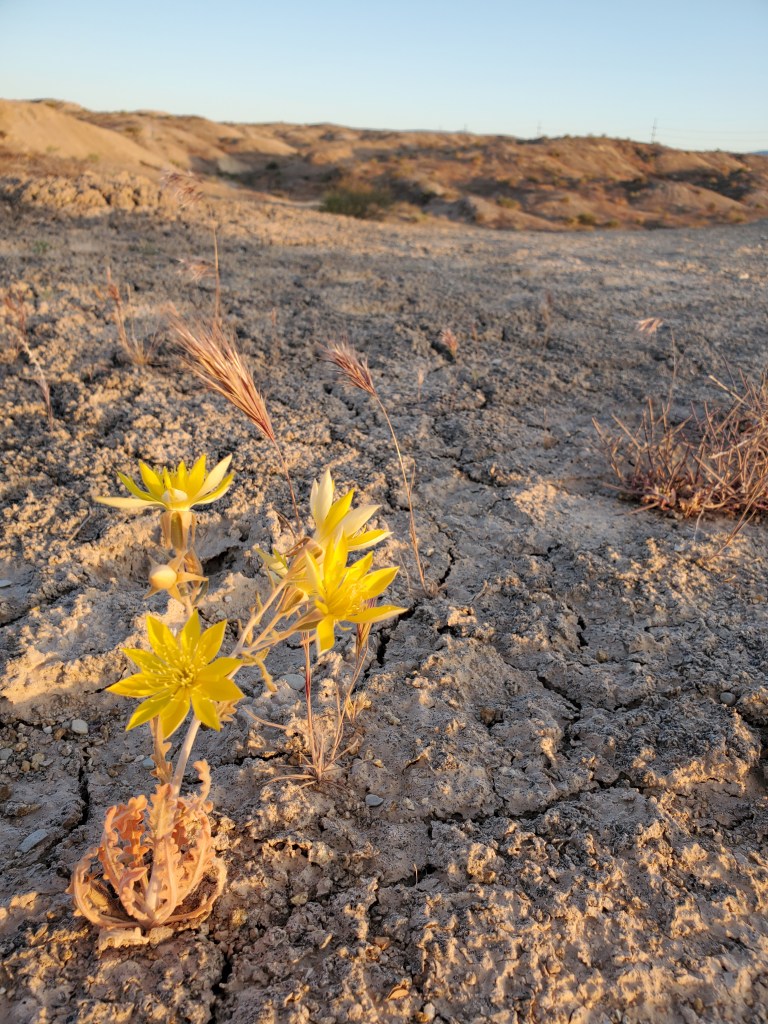
Near Willow Beach, Arizona, along U.S. 93, the basin and range transforms into a series of rolling hills gently cascading to the Southwest. In mid-March we found ourselves passing these hills, on a trip from Las Vegas to Phoenix, and were blessed to see the beginnings of one of the most amazing payoffs of a rainy season in the desert: yellow wildflowers were popping up all over, giving a rich accent to already green grasses.
It was like a scene from a Dr. Seuss book, a rare sight during these past few years of brutal drought. As the rains have soaked deep, many long-dormant seeds have been revived. The result has been a wildly more colorful desert landscape, with visuals that are exceptionally bold and captivating.
Petals and volcanic rock. Photo by ZT.
When it comes to finding a scientific explanation for all this, however, the view starts to get a little more subdued, even dusty. As if driven by some unspoken imperative, some have rushed to define it:
“A superbloom is a rare desert botanical phenomenon in California and Arizona in which an unusually high proportion of wildflowers whose seed have lain dormant in desert soil germinate and blossom at roughly the same time. The phenomenon is associated with an unusually wet rainy season.”
These categorizations often seem too obvious and even hopelessly subjective. So much of it depends on where you happen to be and when you happen to be there. And there’s been a fair amount of debate as to whether this wildflower season actually constitutes a “super bloom” at all. To be sure, it can be more “super” in some places than others.
Ultimately, any hard definitions fall short. The simple truth is there’s just a lot of wildflowers out in the desert right now, and every minute spent worrying about what the phenomenon is or isn’t, is a minute lost to see them while they last. And they won’t last forever; that’s not how the desert works.
Wildflowers at dusk. White Dome Nature Preserve. Photo by ZT.
Thankfully, the act of viewing wildflowers these days requires minimal effort. Under usual conditions, they are subdued, often hidden between larger, less colorful plants. Because of this, they aren’t always readily visible from roadways. But this year, the volume is cranked up so much that it’s possible to get a good view, even while staring lazily out the windows of a car.
To help matters even more, roadsides often provide even more water to the soil because rainwater runs off the edges of the pavement where it soaks into more concentrated areas of disturbed soil. This is why some roads have thicker vegetation (wildflowers included) along pavement edges than might be growing even five or ten feet out into the landscape.
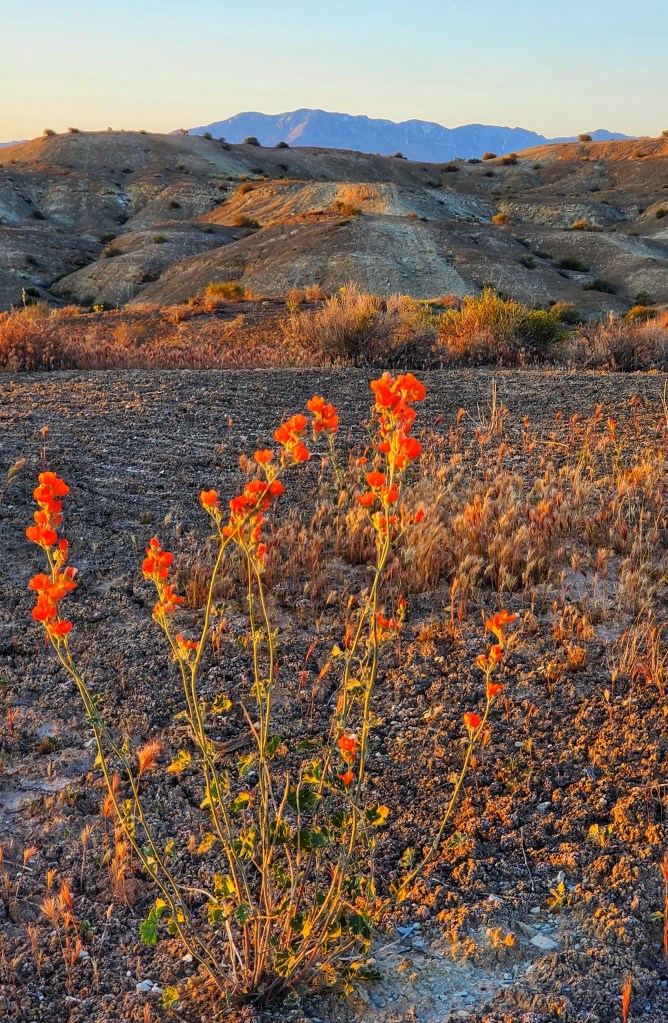
Globemallow, in particular, is making a solid showing along roadsides this year. Of course, it’s equally at home between backcountry boulders, and along footpaths, with its delicate looking pale stems and orange, cup-shaped blossoms that close at night and open toward the rising sun. Globemallow’s height, compared to other flowers, gives it more prominence on the landscape like a highway construction sign.
Globemallow in the desert. Photo by ZT.
Along U.S. 191, near Canyonlands National Park, there are currently great fields of globemallow, stretching across the horizon like orange reflections on a sea of green. Try as you might, casual photos won’t do it justice. You can only hope to enjoy the scenery in the moment and maybe, if you’re lucky, capture some of it in memory.
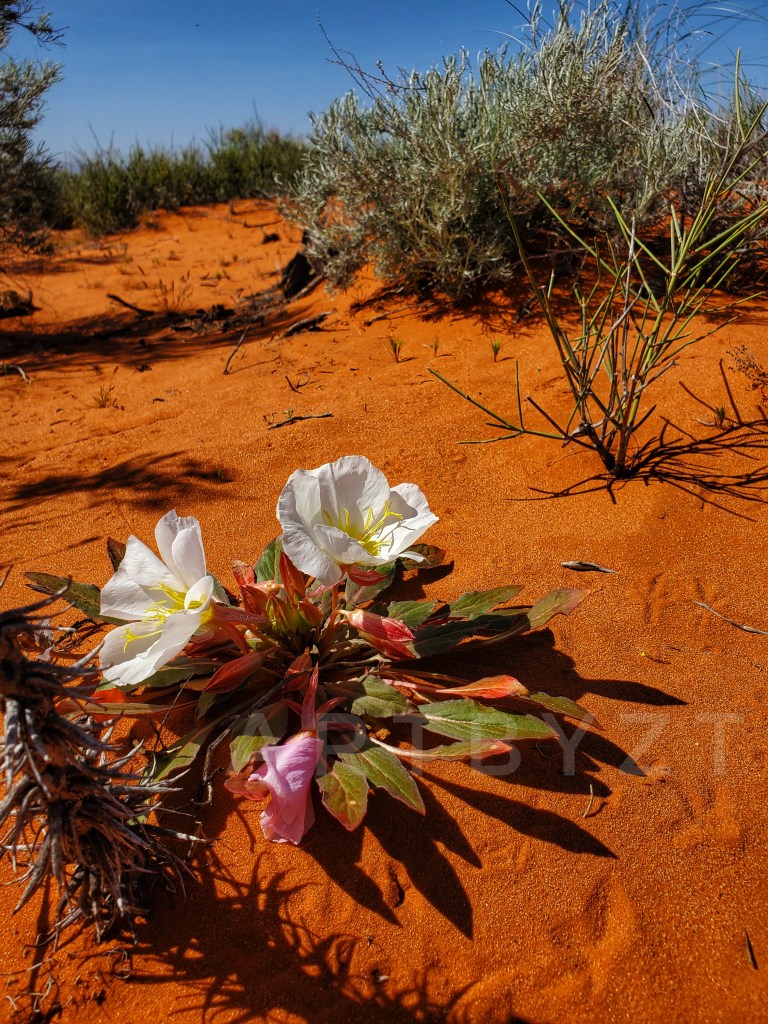
As for the hiking trails, it’s easier to spot shorter specimens like the evening primrose which stands out like a champ–showing white blossoms that look more like they belong in grandma’s garden than on the slopes of any canyon rim or sand dune. The primrose is a dignified, important looking flower that won’t easily be ignored.
Evening Primrose. Photo by ZT.
Picking a favorite among all these is tough, but there are few wildflowers more admirable to me than the California Blue Bell, Phacelia campanularia. This little annual has rich, brightly colored blue buttons fixed on an attractive array of military green foliage. Like the globemallow, it has rounded petals, but they splay out more than globemallow, giving the blossoms a star-like rather than cup-shaped form. The blue bell is much shorter than globemallow and has a bushier outline, but it can brave some of the toughest soils in either the wilds or the garden.
California Blue Bell. Photo by ZT.
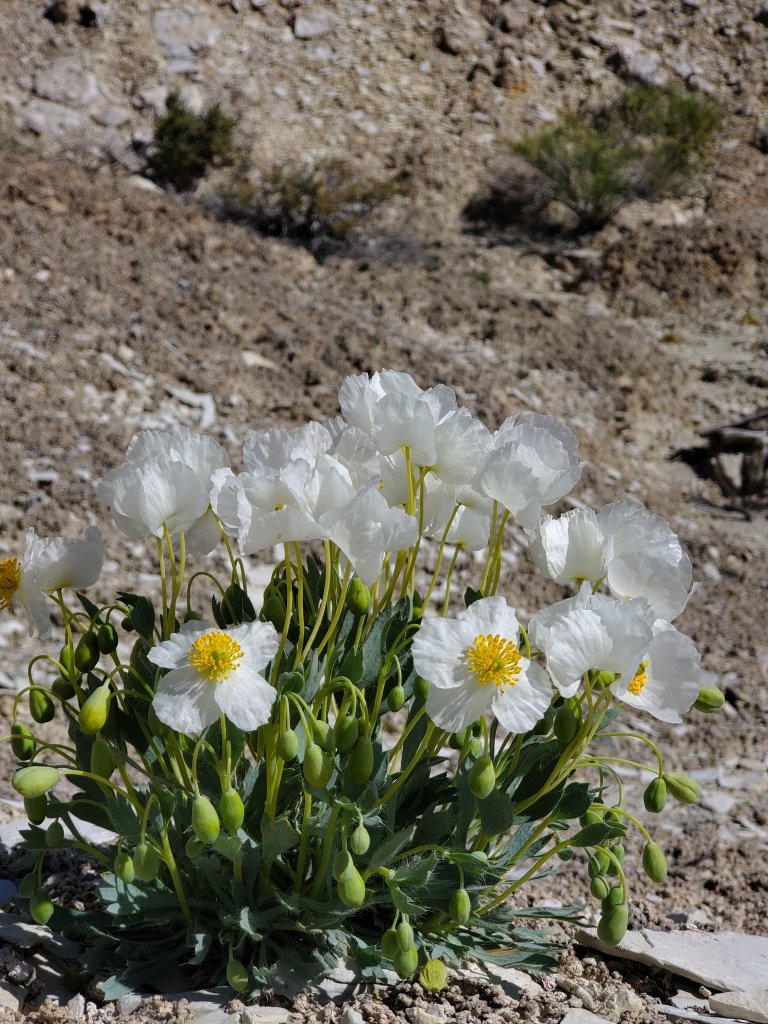
Near the border of Utah and Arizona, there’s a place operated by the Nature Conservancy called the White Dome Nature Preserve. Here is the home of a special wildflower called the dwarf bear poppy and it’s the only place in the world where it can be found in the wild. The dwarf bear poppy stands out magnificently on the harsh landscape, conjuring up the closest thing to what it might look like if there were flowers on the moon.
Dwarf Bear Poppy. Photo by ZT.
I took a short hike through the preserve a few weeks ago. Small patches of poppies could be seen here and there, not in large quantities and spreads, but metered out, with each plant having its own generous amount of personal space. As I walked, the white blossoms and bright green stems seemed to both complement and contradict the surrounding gypsum hills. And the rains had brought blessings here too, with more poppies on display than I had ever seen.
Once again I was grateful for this melding of contrast and consistency so common in nature. It was another landscape paradox, with the poppy as a defining feature–a kind of mascot for what makes wildflower season so special.
How a wandering jaguar changed my view of the wilderness
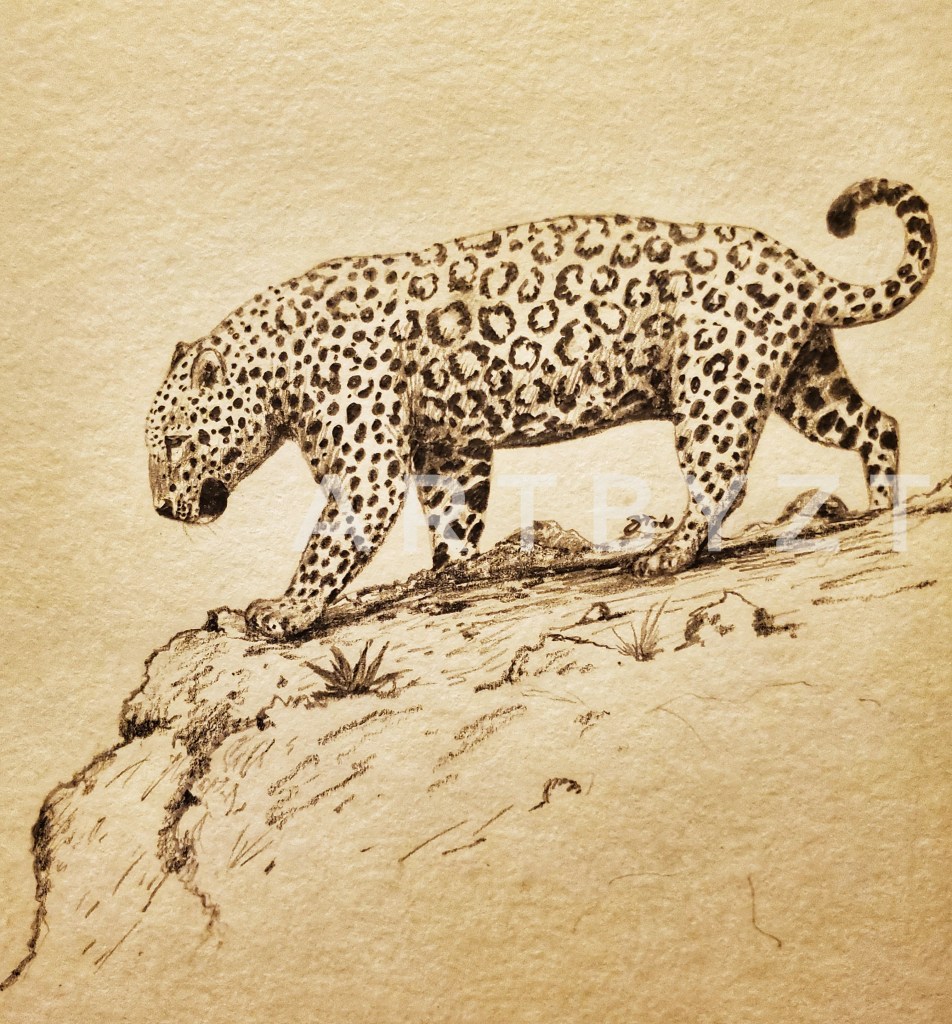
The desert jaguar…Artbyzt.
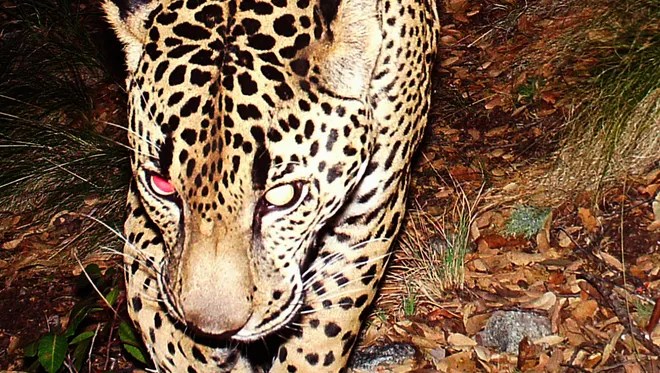
Natural history rarely turns on a dime, but the story of El Jefe the jaguar wasn’t fit for any stale museum halls. It was hard to believe at first. A jaguar. In the mountains of southern Arizona. The trail cam footage on the evening news was captivating, and quickly gained a wide audience.
I’ve always been fascinated by big cats and the mystery and power they bring to the wilderness. But while watching El Jefe, as he deftly crossed a creek bed in the Santa Rita Mountains, I realized my perception of big cat habitat was cliche and needing expansion. It was no longer just about Indian jungles, African savannahs, or the Pantanal of South America–the kind of steamy, verdant, places that are the pride of National Geographic photographers. It was time to consider places lonelier, drier, closer to home.
“He’s got swagger,” I thought, while watching the clip again. “El Jefe…a perfect name for the boss of the desert.” He was definitely going somewhere as he softly stepped over logs and scrubby branches–his eyes like fire and muscles rippling under amber, spotted fur.
I’m not a frequent visitor, but the U.S. / Mexico border doesn’t seem like the place to hang out. It’s troubled there by all accounts, a crossing place for desperate people and criminals–home to impassable walls, and surrounded by unforgiving, often deadly terrain. Water is probably less than scarce, meaning food for any large predators would be scarce too.
And (as was clear in the video) jaguars need room to roam and they need contiguous habitat, which means the border represents a significant obstacle to conservation efforts.
Was he looking for a mate? Escaping an enemy? Or just on patrol, like a junkyard dog checking the edge of his lot? What was his last meal? What would be the next? A javelina? A bird? A snake?
For some time, after being spotted, treed and then photographed by a cougar hunter and his daughter in 2011, El Jefe was documented on trail cameras in the area, with the most public images being released in 2012 by the U.S. Fish and Wildlife Service. He was given his name by students at a middle school in Tucson, and was believed to be part of the northernmost breeding population of jaguars in Mexico. He was important scientifically because he represented one of the only known specimens of jaguar since the species was believed to have been extirpated in the United States. El Jefe (jaguar), Wikipedia, 18 January 2023, https://en.wikipedia.org/wiki/El_Jefe_(jaguar))
There was another, less public, account of a jaguar named Macho B who had been haunting the area in the years prior. And there have probably been others to cross since. But it was El Jefe who became a kind of mascot for amplifying the possibility of jaguars someday living and thriving again in the U.S.
El Jefe, Conservation CATalyst And Center For Biological Diversity. Arizona Sonora News, Posted 17 February 2017
It’s said that jaguars are the third largest of the big cat species, which added another layer of intrigue. Desert climates rarely support large animals, let alone large carnivores. When it comes to the desert, scarce resources usually account for slow, modest growth in plants and everything that depends on them.
To be clear, there are other cats living in improbable places around the world. There are lions on the beaches and dunes of Namibia, leopards on the high cliffs and in the seaside canyons of Oman, tigers in the cold forests of Siberia. And, of course, there’s the snow leopard which seems to be on its own level of habitat utilization.
Leopards, especially, are good at adapting to atypical habitats, as is the case with the urban leopards of New Delhi. Since jaguars in Mexico are on the fringe of their habitat to begin with, Arizona could probably be considered ultra-fringe.
But part of what makes El Jefe’s story so inspiring is that it only appears unnatural on a knee jerk level. In reality, it’s a perfect story from a landscape where surprises are built in.
It could also be said that the personality of the desert is inherently subdued, independent and resistant to categorization. El Jefe, and the other jaguars who crossed the border before him, and undoubtedly since, mirror these traits. Obviously, there won’t be a large population of them in the American desert anytime soon, if ever. But, for now, just appreciating the outliers is good enough for me.
Maybe I’ll travel there someday, to those remote southern mountains, knowing that my chances of seeing a wild jaguar will be next to nothing. But at least I could get closer, and see some of where this story took place, all the while hoping for more to come.
Then, as the fierce daylight fades into purple skies and sparkling stars, I could get goosebumps as I glance back into the scrub. I could move closer to the fire, maybe sip on a mug, and picture that big, inspiring cat, making his rounds, out in the darkness and the rocks.



 The Desert Toad