
Hallucinations…shamans…intense spiritual awakenings…out-of-body experiences…week-long retreats in the desert and drug addiction therapy…
When starting out on a blogging journey, it’s too easy to become grandiose about it. Pomposity can be a pitfall of writing in general, whether it’s the first piece you’ve written or the 10,000th. While establishing a sense of self and purpose, a writer can get wordy, big-headed, overly intellectual, even reaching into the clouds for ideas.
I picked the title of this blog partly because “toad” was a nickname of mine in high school, and partly in an attempt to keep myself from floating too far from the ground while creating content. I figured it might be useful to have an animal avatar to help anchor down whatever I wrote–keeping with stories that were digestible and relatable.
“What better reminder,” I thought, “than the humble toad?”
So when I recently heard about the Sonoran Desert Toad I’ll admit I was troubled.
I’ve long known about toads and their secretions, which can be poisonous to other animals. It’s a natural defense mechanism, basically something that keeps the toad from being eaten.
But apparently the Sonoran Desert Toad has an especially “trippy” secretion that humans have been using to escape reality. Basically, like mushrooms or other hallucinogens, toad poison can be used to get high. And, in this age of fads and self-help fanaticism, toad licking has actually become a thing.
There are now a few places even offering special retreats where you can experience toad ecstasy in a controlled and “supportive” environment.
Admittedly this is probably good, because toads can often be found in remote and dangerous terrain, and it’s not hard to imagine that getting stoned in a slot canyon could easily result in a medical helicopter ride.
Abstinence in this case seems like a no-brainer, but the risky business of wild toad licking has been spotlighted recently in the media, with organizations like the National Park Service finding themselves in the strange position of having to tell people not to do it.
The situation was described in a recent NPR story, featuring an ominous looking Sonoran Desert Toad, with glowing eyes, staring hypnotically into a night-vision camera.
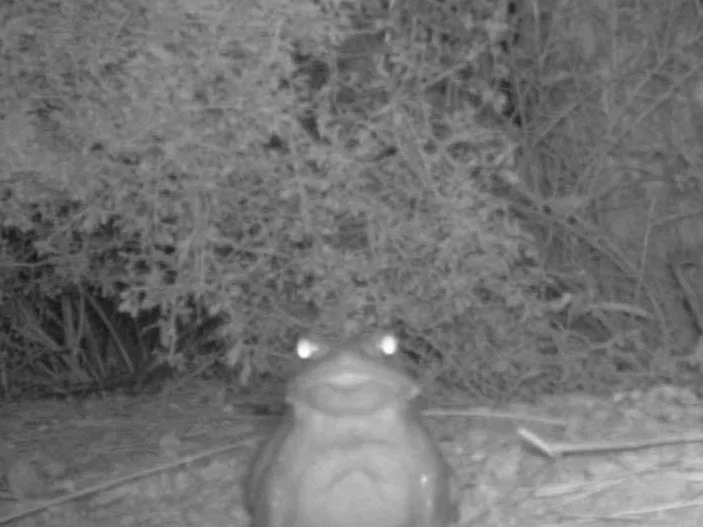
The National Park Service wants humans to stop licking this toad – Kim,Juliana NPR, Nov 6, 2022 https://www.npr.org/2022/11/06/1134615997/the-national-park-service-wants-humans-to-stop-licking-this-toad
While its psychedelic effects are pretty hard to overstate, there are, not surprisingly, divisions about whether the toxin is beneficial or not. According to an article in The New York Times, some even see it as a matter of life or death.
“The effects of the toxin depend on your perspective. Some call it a dangerous poison that can make people sick and can even be deadly. Others call it the “God molecule,” a hallucinogenic so potent it is often compared to a religious experience.”
From an animal welfare and conservation point of view, there are other concerns, which might be partly why the park service saw the need to intervene. Extracting the toxin involves bothering the toad.
“People collect the substance by stroking under the toad’s chin, initiating a defensive response. It then releases a substance that can be scraped, dried and smoked.” – Victor,Daniel, National Park Service Asks Visitors to Please Stop Licking Toads, The New York Times, Nov 7, 2022. https://www.nytimes.com/2022/11/07/us/licking-toads-toxic.html
Regardless of whether it actually causes harm, this kind of manipulation seems extreme and unnatural, but so is a lot of what we do for supposed “health reasons.” Other animal derived products are used for a variety of human ailments.
I’m not really interested in telling people what they should or shouldn’t be doing for their health. But, whether it’s the toads of Arizona, the bison of Yellowstone, or the manatees of Florida, maybe we should just leave wild animals out of it.
These digressions aside, it’s probably no longer possible to disassociate this blog from the Sonoran Desert Toad, at least not in the mind of anyone familiar with its special powers. For a time I thought about changing the name, but at the end of the day it just didn’t seem like the right thing to do. Afterall, I didn’t want all toads to be stereotyped that way, myself included.
There’s just more to toads than the psychedelic. For instance, I first caught a regular old toad in a field of zucchini plants as a boy, and I held it for a few moments. It was the kind of novel childhood experience that was hard to forget. I marveled at the bumpy skin that was cool to the touch–not slimy, but not really dry either–and the fat little belly that squished around like a hacky sack.
When I was done, I put the toad back down in an irrigation row and watched him wriggle his way into the damp soil until he had completely disappeared, like magic, beneath the surface. This wasn’t a hallucination, just real life.
Of course, I’ve also caught other toads since. After accidentally leaving a garden hose running, I found a spadefoot toad paddling around in the bottom of a window well behind our house. I put him on a wet paper towel and got a few pictures before letting him go.

Toads often emerge from unexpected places after periods of heavy rain or flooding. When they’re above ground, they can eat a lot of bugs and do a lot of good for the environment in short order. Otherwise, they just stay dormant for long periods underground.
To be fair, the title of toad is also not just restricted to the amphibious kind. I’ve occasionally caught “horny toads,” officially known as Desert Horned Lizards. Some of these interactions I’ve already recounted in blog form.
Yet despite the odd capture here and there, I’ve never kept any wild toads and don’t really intend to. Even though they appear to be humble and hardy, they’re not ideal pets.
Either way, they can be admired and emulated to some extent. That’s ultimately why I decided to keep the blog name, knowing that it would still provide me with a needed reminder to keep thoughts down to earth and away from any “tripping.”
Simple thoughts, simple writing. In order to stick with this, and stay true to the people who’ve done the kind of writing I admire, I’ll need to stay focused.
I’m talking about writers like Edward Abbey, Thoreau, Russell Baker, E.B. White and Anne Lamott. Keep it simple, stupid, they’d say. Write like you mean it. Don’t float around or hallucinate too much.
And so I’ll just remind myself to embrace (not lick) my own toad ideal. On the ground and out of the clouds.
In the Lynyrd Skynyrd song Simple Man, a mother tells her son to be “…something you love and understand.” So, even if the toad lickers carry on, I’ll carry on too, writing words to the best of my ability, trying to keep plain and simple thoughts at the forefront, while hoping to provide a little surprise or some deeper insight from time to time.
I know it won’t always be easy. Writing can be like an alternate universe where gravity pulls you up instead of down. But with the simple kind of toad as an example, and with some dedication to the craft, I just might have a chance.
 The Desert Toad